|
Establishment of the Information Center of Hokkaido University of Education for Environmental Education
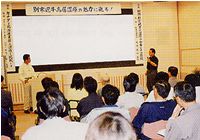
In January 1998, the Information Center of the Hokkaido University of Education has been established at the Kushiro Campus, after a half year preparatory period. The purpose of the center is to establish fundamental and practical studies on the problems of environmental education, to collect information about the environment and environmental education, to properly utilize the information in schools and lifelong education, and to examine their methodology. As the result of these activities, a bulletin, "Journal of Environmental Education, Vol. 1" was published in March 1998, which contains a total 21 papers and/or reports, and on the basis of that publication a symposium commemorating the establishment of the center was held at the Kushiro
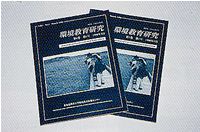 Campus in June. Campus in June.
It is worth sharing several titles of papers in this issue to introduce the aims and activities of the center all around: "The deepening of environmental education by encouragement of ecological literacy" "Consciousness, vocabularies and rhetoric of dairy farmers' life and farming strategies: A qualitative investigation at Betsukai, Hokkaido" "Salmon studies through the internet system between Shibetsu Salmon Museum and Kiritappu Junior High School (I): A joint lesson of Watching of salmon's spawning behavior" "Adventure education programs of Kushiro and a study on the change of the self-concept of the program participants" "Role of Learning by doing about nature, society and life in the Moving of children from urban school to rural school" "Tephrochrono-logical earth history: teaching materials for paleoenvironmental education in Kushiro and Shari areas" "Where are the summer living sites of native crayfish Cambaroides japonicus in Onnenai area, Kushiro Marsh?" "A case study of local environmental education: International exhibition of children's pictures on cranes in Kushiro"
(Home page: http://environedu.kus.hokkyoudai.ac.jp)
Shin-ichi Hiruta
Assistant Professor of Biology
Hokkaido University of Education,
Kushiro Campus
Comparison of Wetlands in Canada and Eastern Hokkaido
- From the lecture by Professor Warner -
Mr. Barry G. Warner, professor of the University of Waterloo, visited Akkeshi for his research on the bog mires of Bekanbeushi-shitsugen, Akkeshi, from June 17 to 24, 1998. The following are outlines of his lecture at the Akkeshi Information Library on June 23:
Prof. Warner first explained about the Canadian wetland classification system, based on a book his group has recently compiled and published. The first edition of the book, also entitled "Canadian Wetland Classification System," was published in 1987. It took 10 years for the authors to revise the book. In the book, wetlands in Canada are organized into five classes. The first class, called the bog wetland class, contains basin bogs and blanket bogs. The second is the fen wetland class, which is characterized by a high groundwater surface level, almost as high as the land surface, and containing abundant minerals. The third is the swamp wetland class. This class, also called swamp forests, is characterized by having a wide variety of minerals and a high groundwater surface level, which is as high as - or sometimes higher than - the land surface. The fourth is the marsh wetland class, which is a shallow water characterized by the accumulation of small amounts of organic matter and peat. The fifth is the shallow water wetland class, which is a transitional stage of wetlands between the above-mentioned fourth class wetlands and lakes.
Prof. Warner said that wetlands along the Bekanbeushi River are truly unique in that raised bogs have developed in the center and a mixture of fens and swamp forests are
 observed around them. Prof. Warner also said that wetlands demonstrate the topographical history of the local area. It is thus important to examine the topographical history of Bekanbeushi-shitsugen and compare it with those of other areas worldwide. In Bekanbeushi-shitsugen, tefra zones have been incorporated in the process of wetland formation, making this wetland unique not only compared with Canada but also rest of the world. observed around them. Prof. Warner also said that wetlands demonstrate the topographical history of the local area. It is thus important to examine the topographical history of Bekanbeushi-shitsugen and compare it with those of other areas worldwide. In Bekanbeushi-shitsugen, tefra zones have been incorporated in the process of wetland formation, making this wetland unique not only compared with Canada but also rest of the world.
Fusayuki Kanda
Professor of Biology
Hokkaido University of Education
Kushiro Campus
Endangered Hucho perryi in Kushiro-shitsugen
Hucho perryi living in Kushiro-shitsugen are on the verge of extinction. Hucho perryi belong to the salmon family and is Japan's largest freshwater fish, with an overall length of more than one meter. Although this fish used to live also in northern Honshu, Japan's mainland, it currently inhabits only Hokkaido. Hucho perryi of the same type can also be found in Primorski Krai, Sakhalin and the southern Kuriles. The spawning season of Hucho perryi is from April through May. The fish goes upstream to spawn around the time when the quantity of snowmelt begins to increase. Unlike salmon, Hucho perryi survive for more than 15 to 20 years after they spawn. Such longevity is the main reason the fish grow so large. However, they grow remarkably slowly: the male becomes mature at the age of six or seven, when its length is approximately 45 cm, and the female at the age of eight when 55 cm long. Although Hucho perryi with a length of over 30 cm usually live only on fish, they may also eat mice, frogs and snakes as they grow larger.
In recent years, Hucho perryi have rarely been caught in Kushiro-shitsugen, and there is much concern about its existence. In research conducted over three years from
 1995 to 1997 on rivers around the wetland, only one Hucho perryi fry was found. This indicates that the habitat of Hucho perryi in Kushiro-shitsugen has significantly worsened in recent years. It is necessary to conduct artificial hatching and stocking of the fish, while confirming that it still has access to natural breeding areas. Preservation of Hucho perryi will involve conserving the entire catchment area, including
Kushiro-shitsugen. 1995 to 1997 on rivers around the wetland, only one Hucho perryi fry was found. This indicates that the habitat of Hucho perryi in Kushiro-shitsugen has significantly worsened in recent years. It is necessary to conduct artificial hatching and stocking of the fish, while confirming that it still has access to natural breeding areas. Preservation of Hucho perryi will involve conserving the entire catchment area, including
Kushiro-shitsugen.
Tsutomu Haryu
Curator
Kushiro City Museum
|
1998 Project Plan |
Training
Assisting with the JICA Training Course on Nature Conservation and Natural Parks Management (Sept.); Commissioned with Conducting the JICA Training Course on Wetland Conservation and Protection of Migratory Birds (Oct.)
Conferences & workshops
UNITAR/KIWC Environmental Law Training Workshop (Sept.)
Research & monitoring
Technical Committee activities: "On-site Environmental Education in Eastern Hokkaido Wetlands"
Awareness-raising & promotion campaigns
Issuance of newsletters; Publication and translation of a book entitled "Economic Valuation of Wetlands" (March)
International cooperation & cooperation with other organizations
Cooperation by participating in the Crane Site Network; Cooperation with the conference of municipalities associated with the Ramsar Sites (Oct.); Promotion of the project to respond to Recommendation 6.3 of the Ramsar Brisbane Conference |

|

|
| 次ページへ |
|
|