Topics
-
2017-02-21
topics > No.35
Celebrate World Wetlands Day with Winter Eco Tour 2017 at Lake Takkobu
In celebration of World Wetlands Day 2017 (celebrated internationally each year on 2 February), we hosted Winter Eco Tour 2017 for local residents on Saturday, 4th February 2017.
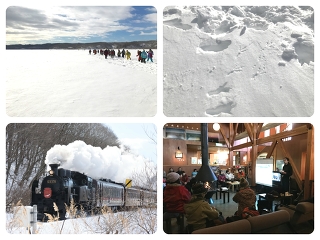
The event took place at Lake Takkobu in Kushiro Wetland and Mr. Hisashi Shinsho, the Chair of the KIWC Technical Committee, provided commentary during the field tour. We walked up to the source of stream by the lake and observed water spring out of the ground and frost flowers (delicate ice structures) bloom around the source. We then walked across the snow-covered frozen lake and found animal tracks in the snow and snow ripples.
In the afternoon, KIWC gave a presentation on Wetlands for Disaster Risk Reduction, which is the theme for this year’s World Wetlands day, and explained about how Kushiro Wetland played an important role in flood management and disaster risk reduction during the massive typhoon that struck Hokkaido in August 2016.
We also did quiz completion regarding Kushiro Wetland In the bus on our way to Lake Takkobu and the participants had a great time taking part in it.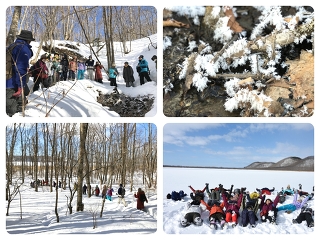
-
2016-11-05
topics > No.34
JICA Anzali Wetland Ecological Management Project – Training in Japan
KIWC hosts JICA Country-focused Training on the Anzali Wetland Ecological Management Project Phase II as part of an ecological management project organized by the Japan International Cooperation Agency (JICA) for Iran’s Anzali Wetland. The training was provided in various parts of Japan from 9 October to 22 October, 2016. The course was attended by 7 high government officials from Iran who are involved in wetland ecological management and basin control.
From 12 October to 15 October, the training was provided in the Kushiro region. The participants visited the Kushiro Wetland and neighboring facilities. They learned about a nature restoration project being implemented for the wetland and canoe tour operation on the wetland.
KIWC hosted a lecture to highlight the history, conservation and wise use of the Kushiro Wetland. At the Kushiro Marsh Observatory, the Onnenai Boardwalk and the Institute for Raptor Biomedicine Japan, the participants were provided with commentary on the facilities’ roles in the wetland and their operation and they actively asked questions. They also visited Shibecha High School, where the students explained about their Kushiro Wetland Nature Restoration Project, which is making a concerted effort to conserve wetlands and promote technical development for that purpose
A discussion and exchange session was held on 15 October to roundup the training in Kushiro with the attendance of KIWC staff, local residents and local government officials involved in the conservation of the wetland. The attendees engaged in lively discussions with the participants. Finally, the KIWC Secretary General wrapped up the session with some general comments, highlighting hopes for the development of exchanges and collaboration among people involved in the conservation of the Kushiro Wetland and the Anzali Wetland in the future.
This training was run by Nippon Koei Co., Ltd. under commission from JICA.
-
2016-11-05
topics > No.33
KIWC Technical Committee On-site Study Meeting 2016
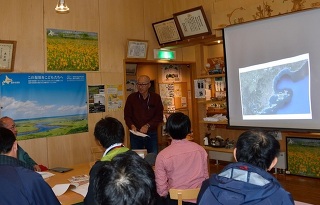
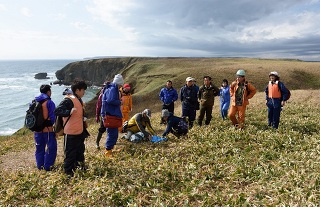
On 20 October 2016, the KIWC Technical Committee held an on-site study meeting to examine case examples under its 2016 – 2018 research theme of “the wise use of wetlands”. Committee members visited Kenbokki Island, an uninhabited island in Hamanaka Town under the guidance of Mr. Urita, Vice President of NPO Kiritappu National Trust and Ms. Kouchi, member of KIWC Technical Committee and staff at Kiritappu Wetland Centre. Committee members then had a lively exchange of views about eco-tourism at Kenbokki Island.
-
2016-10-28
topics > No.32
Public Participation Survey of a Restored River Environment – Autumn 2016
On 16 October 2016, a public participation survey on a restored river environment was conducted in the Kushiro River section where the meander was restored to a natural stream section (approximately 5.5 kilometers from Kayanuma to Sugawara). Participants canoed down the river, observing riverbank vegetation, landscapes, animals, plants and other elements of the surrounding environment along the way. They stopped at a sandbank to examine their size and geological formations.
After completion of the survey, participants summarized their findings and results. They shared a great deal of information, such as it was their first time to see white-tailed eagle, many fallen trees along the river after a massive typhoon tore through the eastern Hokkaido in August, and the difference in water colour between the two streams at their confluence.
The event was originally planned for 17 September, but was postponed to 16 October 24 due to the typhoon.
This initiative was implemented with river improvement funding provided by the River Foundation.

-
2016-10-17
topics > No.31
KIWC hosts JICA Training Program on Eco-tourism for Officials on Nature Conservation
From 23 August to 5 October 2016, KIWC ran a training program under commission from the JICA Hokkaido International Center (Obihiro). The aim of this training was to provide insight into eco-tourism programs involving local residents as a tool for the conservation and sustainable use of local natural and cultural resources. Six government administrative officials and NGO staff members involved in tourism promotion and wildlife protection from nine countries attended this training program. Countries represented were Georgia, Myanmar, Philippines, Samoa, Suriname and Vietnam.
The participants experienced eco-tours involving local residents that take local environments and wildlife into consideration at Nakasatsunai Village, Lake Shikaribetsu and Kushiro wetlands (specifically Kiritappu-shitsugen, Bekambeushi-shitsugen and Kushiro-shitsugen). There, they witnessed examples of sightseeing tours operated by local residents that take advantage of local industries, such as agriculture, livestock farming and fisheries.
The participants then traveled from Hokkaido to Tokyo and Kyoto to participate programs allowing them to gain insight into the perspective of eco-tourism from certain aspects of Japanese history and culture, including Japanese traditional way of life, and historic sites. They were also given presentations on eco-tourism theories and policies. The participants also visited Okinawa, where they participated in sea kayaking and other programs to learn how local people utilize eco-tourism with their viewpoints and experiences.
On the last day of the course, the participants presented their final reports at the JICA Tokyo International Center. The concepts were tailored to actual situations in each country, and included ideas developed in Japan to encourage the use of natural and cultural regional assets in order to promote tourism and the allocation of profits in a way that will benefit the relevant locality.


