|

Sakata
 Lake
Biwa, the largest freshwater lake in Japan, is internationally famous as one of the world's oldest lakes. Located in the center of Shiga Prefectural Government, this lake has a circumference of 235 kilometers and covers an area of 65,602 hectares, accounting for one sixth of the entire area of the prefecture. The shape is longer in the north-south direction and narrow in the middle. Therefore, the northern part is called Hokko (northern lake) and the southern part Nan-ko (southern lake). The area around Nan-ko has been urbanized and many buildings, houses and factories have been constructed there. Meanwhile, the area around Hokko retains a relatively natural environment, with paddy fields and reed colonies. Lake
Biwa, the largest freshwater lake in Japan, is internationally famous as one of the world's oldest lakes. Located in the center of Shiga Prefectural Government, this lake has a circumference of 235 kilometers and covers an area of 65,602 hectares, accounting for one sixth of the entire area of the prefecture. The shape is longer in the north-south direction and narrow in the middle. Therefore, the northern part is called Hokko (northern lake) and the southern part Nan-ko (southern lake). The area around Nan-ko has been urbanized and many buildings, houses and factories have been constructed there. Meanwhile, the area around Hokko retains a relatively natural environment, with paddy fields and reed colonies.
Some 460 rivers and water channels of various sizes flow into the lake from throughout the prefecture, but only the Seta River and Lake Biwa canal flow out of the lake. The Seta River joins the Yodo River and flows into Osaka Bay. This lake contains 27.5 billion square meters of water - a volume considered to take about 19 years to be replaced entirely. It is said that this lake was named after "biwa" - a Japanese lute - because its shape is similar.
Lake Biwa, where over 60,000 geese (including bean geese) and whistling swans gather every year, is one of the most famous wintering sites for migratory birds in Japan. The Prefectural Wildlife Protection Area has been established covering Lake Biwa and the surrounding area, which is also designated as a quasi-national park. Improvement of the water quality is promoted under the Ordinance on the Prevention of Eutrophication of Biwa-ko. In addition, the conservation of reed colonies - an important waterfowl habitat - is also promoted through the Reed Colony Conservation Ordinance.
Since Lake Biwa meets the criteria for designation as a Ramsar site under the Ramsar Convention, and its importance is recognized worldwide, it was registered as a Ramsar site together with Kiritappu-shitsugen (Kiritappu Wetland) and other Japanese sites in June 1993, when the Ramsar Conference was held in Kushiro.
Recently, new conservation measures have been implemented as new systems were introduced to reexamine the functions of Lake Biwa, and recognize the importance of mountains and forests as a water source. In addition, approaches involving not only the administrative bodies but also companies and local residents have been promoted.
One such approach involved organizing the Biwako Ramsar Network, which was established in February 2000 by the Shiga Prefectural Government and 21 municipalities around Lake Biwa. This network intends to promote the conservation of Lake Biwa based on the "wise use" encouraged by the Ramsar Convention, by encouraging citizen-level activities and exchanging information with other wetlands. It is extremely important for residents around Lake Biwa to share their ideas and cooperate in the protection of the natural environment of Lake Biwa, therefore this network is expected to play an important role in promoting conservation activities by getting involved in and supporting local citizen activities.
(Photos)
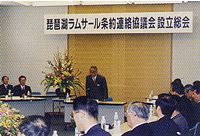
Right: General Meeting to Inaugurate the Biwako Ramsar Network, held at the Lake Biwa Museum in Shiga Prefectural Government on February 5, 2000
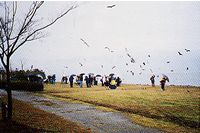
Left: Simultaneous Waterbird Observation at Lake Biwa, an event held simultaneously at eight different locations along the lakeshore on February 6, 2000
Nature Conservation Division,
Shiga Prefectural Government
|
TOPICS |
Lake Akan International Symposium
- Marimo in the World -
The first "International Marimo Symposium," Lake Akan 1999, was held at Akan Town on October 11, 1999, with the theme "Marimo in the world."
Marimo (Cladophora aegagropila) is a green freshwater alga that is found at high latitudes in the Northern Hemisphere, and is famous for developing spherical aggregations. The Marimo population in Lake Akan is designated as a special natural monument and its conservation is of popular interest in Japan.
 In the symposium, a guest speaker, Dr. Arni Einarsson, director of Myvatn Research Station, Iceland, discussed the historical and current situations as well as prospective tasks regarding biological research and conservation of Marimo in Japan and Iceland. The significance of promoting international collaboration was appreciated based on the importance of Marimo as a primary producer in the lake ecosystem and its value as a rarity. In the symposium, a guest speaker, Dr. Arni Einarsson, director of Myvatn Research Station, Iceland, discussed the historical and current situations as well as prospective tasks regarding biological research and conservation of Marimo in Japan and Iceland. The significance of promoting international collaboration was appreciated based on the importance of Marimo as a primary producer in the lake ecosystem and its value as a rarity.
This symposium will continue to be held annually.
Isamu Wakana,
Curator,
Akan Town Board of Education
Photo: Shigenori Sato |
|